About All Tours 3 Days Safari Tours2 Days Safari ToursTsavo East & West ToursFrom Diani ToursFrom Mombasa Tours Directions Hours & Fees Guides
Find Tours 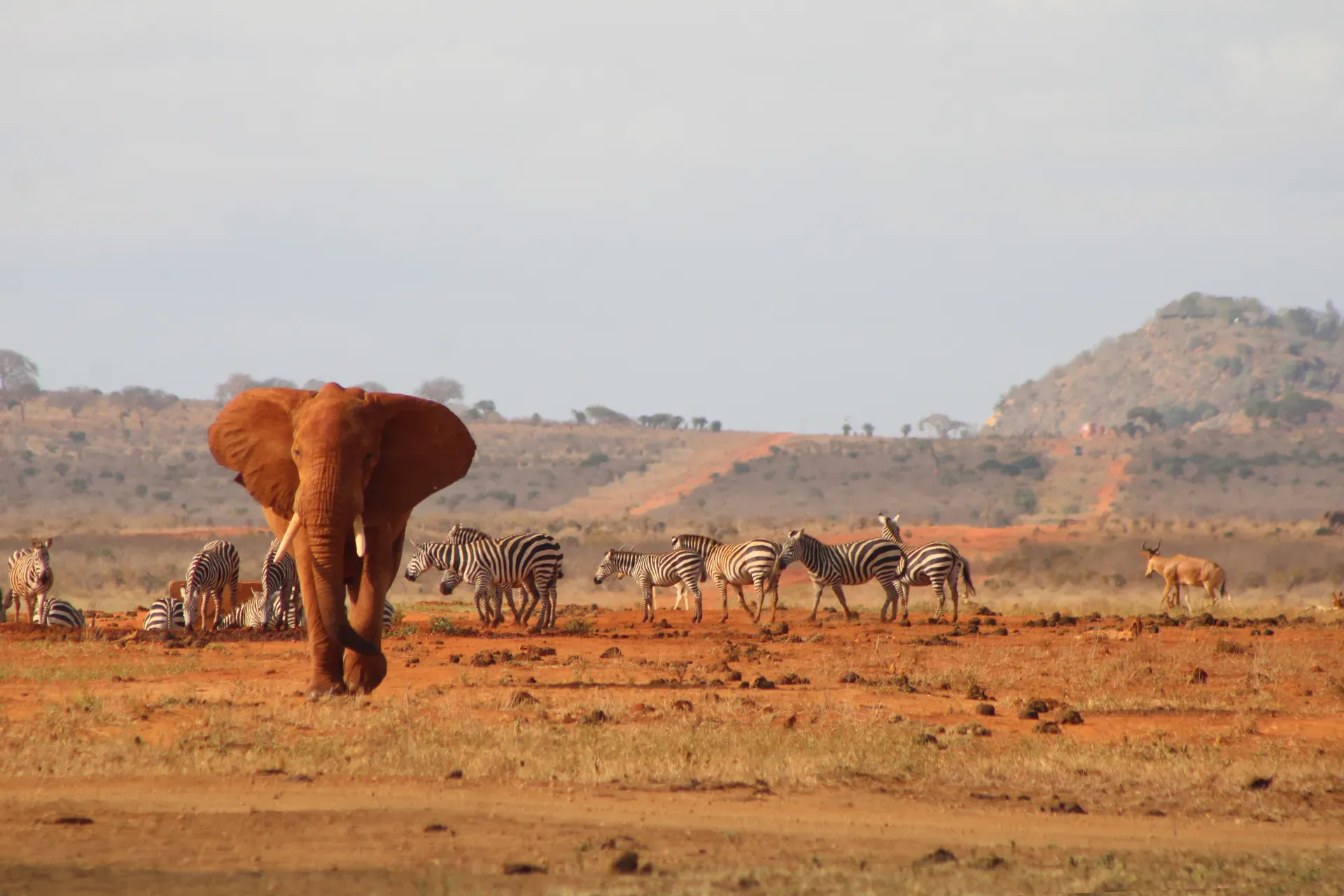
Tsavo East is Kenya's largest national park — 13,747 km² of red-dust savannah in the country's southeast, famous for dust-red elephants, maneless lions and the 1898 man-eater legend, barely 110 km from the Mombasa coast.
Tsavo East is Kenya's largest national park: 13,747 km² of semi-arid bush and open plains in Taita-Taveta County, roughly halfway between Nairobi and Mombasa. Gazetted in April 1948 and managed by the Kenya Wildlife Service (KWS), it sits on the bed of the old Taru Desert. The land is flat, dusty and, in the dry season, pale gold to the horizon. The Maasai Mara gets the crowds; Tsavo East gets the space.
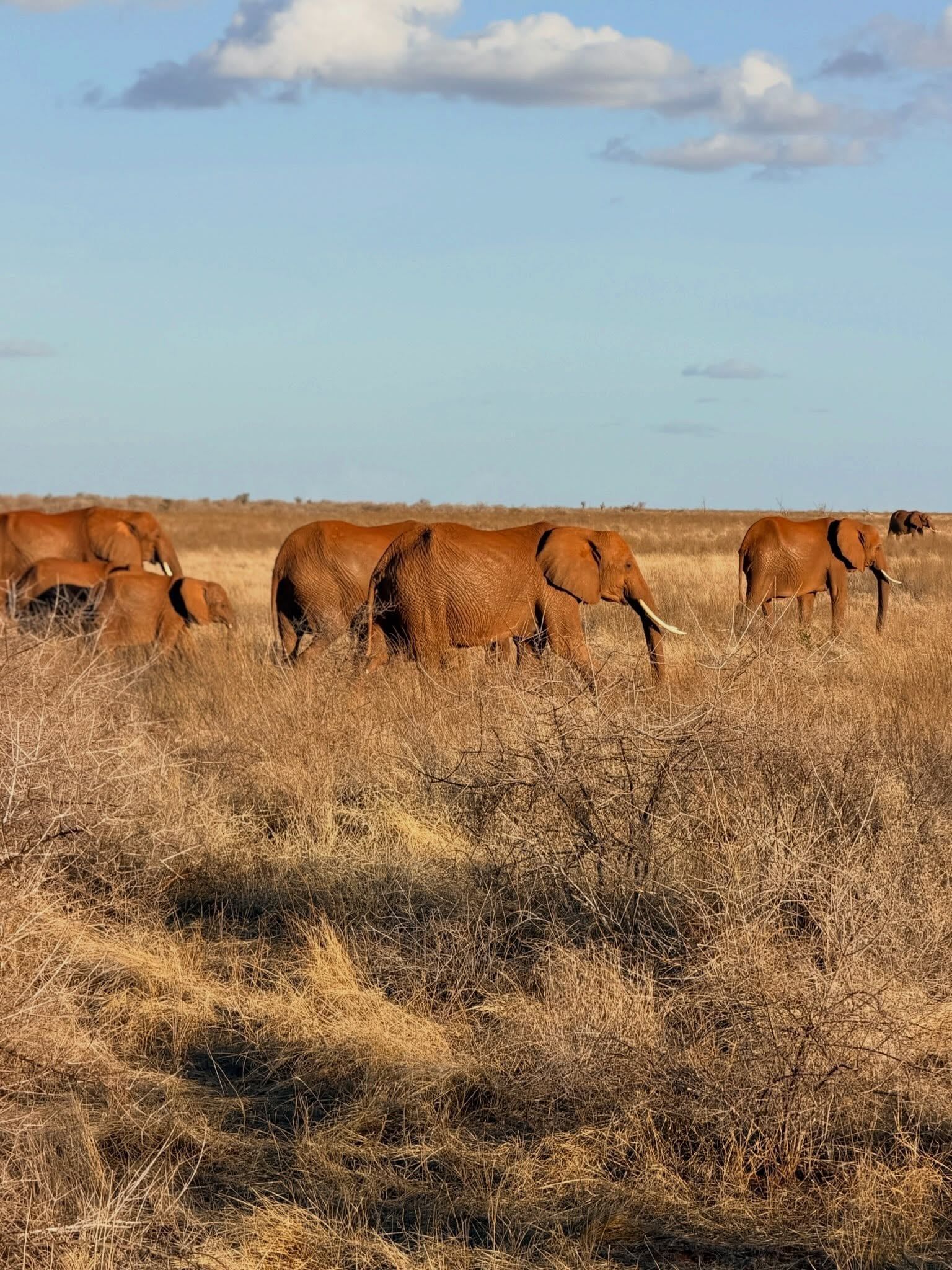
The elephants are the reason most people come. They wallow in the park's fine red soil until their grey hides turn rust-coloured, and big family herds gather to drink and cross at the Galana River and Aruba Dam. The lions are unusual too — males here grow sparse manes or none at all, an adaptation to hot, thorny country. Rarer residents include the critically endangered hirola antelope, gerenuk and lesser kudu, and birders have recorded more than 500 species. Together with neighbouring Tsavo West, the park anchors a protected area of roughly 22,000 km², about the size of Wales, and one of Africa's biggest elephant strongholds.
For visitors, the practical appeal is how close it sits to the coast. Bachuma Gate is 110 km — about 2.5 to 3 hours — from Mombasa, and once inside you can drive for three hours without meeting another vehicle. Days average around 31°C, nights about 20°C. Most trips run two days and one night, with morning and afternoon drives and stops at Lugard's Falls and Mudanda Rock. Book that, not a rushed day trip from the beach.
The Uganda Railway reached Tsavo in the 1890s, laid inland from Mombasa by crews of imported Indian labourers under British engineers. It was expensive, dangerous work, and in 1898 the danger grew teeth. Two maneless male lions began pulling workers from their tents along the line near the Tsavo River.
Between March and December 1898 the pair killed dozens of men. Early accounts put the toll above 100; isotope and DNA analysis of the lions' remains a century later cut the figure to around 35. Lieut.-Col. John Henry Patterson, the engineer in charge of the bridge works, shot both animals that December after months of failed hunts. Their skulls and skins have been displayed at Chicago's Field Museum since 1925, and Patterson's 1907 book, 'The Man-Eaters of Tsavo', turned the episode into one of the most-read wildlife stories ever written.
Protection came half a century later. In April 1948 the government gazetted Tsavo East as one of Kenya's first national parks, with Tsavo West set aside alongside it. The Kenya Wildlife Service took over management in 1989 and still runs both parks. Their elephants became famous worldwide for the red dust they coat themselves in, and the two parks together now form the Tsavo Conservation Area — at roughly 22,000 km², the largest protected wildlife area in Kenya.
KWS markets the park as 'Theatre of the Wild', a nod to both the man-eater story and the open stage of the plains. The standard entry tariff was rewritten in October 2025, the first revision since 2007, setting non-resident entry at USD 80 per adult per 24 hours. Meanwhile the SGR railway still runs along the park's edge, so passengers on the Nairobi–Mombasa line look out on the same country where the railway workers died.
Two rivers define the park. The Tsavo and the Athi meet inside its boundaries to form the Galana, whose emerald water then cuts through arid scrubland for the length of the park — a green line through country that is otherwise dusty and dry. Along the western edge runs the Yatta Plateau, a fossilised lava ridge that KWS describes as the world's longest lava flow. Driving beside its escarpment gives you the clearest sense of the park's volcanic origins and its sheer scale; the view runs over semi-arid scrub for kilometres.
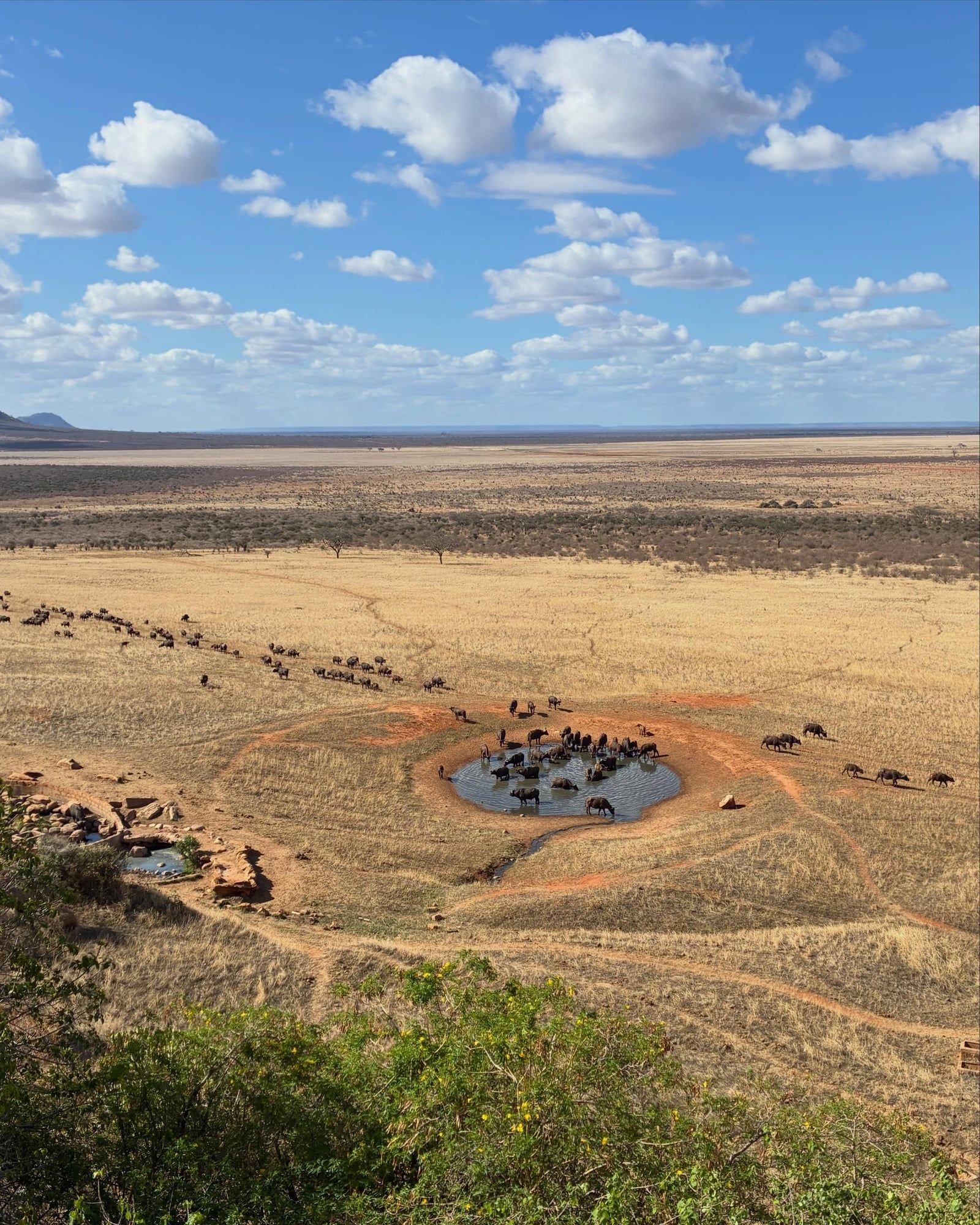
On the Galana sits Lugard's Falls, where the river funnels through and over polished ancient rock in a run of rapids and sculpted channels. It's the park's most dramatic scenic stop, and the pools below hold crocodiles and good birdlife. About a 90-minute drive away, Mudanda Rock is a huge inselberg that works as a natural water catchment, feeding a dam at its base. Elephants, zebra and antelope come to drink there, and a short climb onto the rock puts you above them with a lookout over the plains. Bring binoculars.
The terrain is classic dry-country savannah — flat, open, and far easier for spotting animals than the wooded parks further west. Daytime temperatures average about 31°C and drop to around 20°C at night, so dawn drives want a fleece even in the dry season. Rain peaks in April and November, and when it comes the dirt tracks can turn to mud. Stick to June–October or January–February and you get thin vegetation and animals crowded around the Galana and Aruba Dam instead.
No other African park has a horror story at the centre of its fame. The 1898 man-eaters made Tsavo's name a century before safari marketing did: Patterson's 1907 book has never been out of print for long, the lions themselves stand behind glass in Chicago, and the 1996 film 'The Ghost and the Darkness' retold the story for Hollywood. Museum researchers are still publishing new findings on the pair — the 2017 isotope study that revised the death toll is the most recent.
For Kenyans, Tsavo is inseparable from the railway. The Uganda Railway — nicknamed the 'Lunatic Express' — was the engineering project that stitched together the British East Africa colony, and Tsavo is where it exacted its most famous price in lives. The modern SGR line runs close to the old route, so the country's newest train passes the ground where its oldest railway legend was made. The Waata (Waliangulu), hunter-gatherers of the Tsavo bush, were known for generations as its most skilled elephant hunters before the park era closed that livelihood.
Today the park is the economic anchor of Taita-Taveta County and the backbone of the coast safari circuit, feeding visitors between Mombasa, Diani and the interior. KWS sells it as 'Theatre of the Wild'. For most travellers, though, what sticks is simpler: red elephants crossing a pale river, with nobody else watching.
Tsavo's elephants aren't red by breed. They bathe and dust themselves in the region's fine red laterite soil, which coats their grey skin rust-red — most visible at Aruba Dam and along the Galana River.
Tsavo's male lions grow sparse or absent manes, an adaptation linked to the region's heat and thorny bush. They are the same population that produced the 1898 man-eaters.
The man-eaters were long blamed for over 100 deaths. Isotope and DNA analysis of their remains, published in 2017, put the real figure at around 35 railway workers.
The Yatta Plateau, running along the park's western edge, is described by KWS as the world's longest lava flow — a fossilised ridge of volcanic rock from a single ancient eruption.
The park supports the hirola, a critically endangered antelope with fewer survivors in the wild than almost any other large African mammal, plus dry-country specialists like gerenuk and lesser kudu.
The SGR Madaraka Express runs along the park's edge, and passengers between Nairobi and Mombasa look out on the same country where the 1898 man-eaters hunted railway workers.
Kenya bans single-use plastics in all its national parks. Water bottles, plastic bags and food wrappers must be left behind or carried out — rangers enforce it at the gates.
Under the KWS tariff effective 1 October 2025, non-residents pay USD 80 per adult and USD 40 per child (3–17) for a 24-hour visit. African citizens (non-EAC) pay USD 40/20, Kenya residents KES 1,350/675, and East African citizens KES 1,000/500. Vehicle entry is extra — KES 600 per day for cars under 6 seats — and children under 5 enter free.
The park is open daily year-round. Gates open at 6:00 AM and close at 6:00 PM unless you're staying overnight inside the park. Your ticket is valid for 24 hours of continuous stay rather than per calendar day, and night driving is banned.
Take the Mombasa–Nairobi highway: Bachuma Gate is 110 km from Mombasa (about 2.5–3 hours) and Voi Gate is 156 km. Most visitors come on organised 1–3 day safaris from Mombasa or Diani, typically entering at Bachuma for morning and afternoon game drives.
Yes. The SGR Madaraka Express stops at Voi and Miasenyi stations, about 4 hours from Nairobi (KES 1,050 economy, KES 3,200 first class to Voi). You'll need a pre-arranged transfer of roughly 30–60 minutes from the station to your gate or camp. Book on the official metickets.krc.co.ke portal well ahead.
All five — lion, leopard, elephant, buffalo and rhino — live here, but densities are lower than in the Maasai Mara. The trade-off is genuine wilderness with almost no other vehicles. The park is most reliable for its red elephants, plus rarer species like gerenuk and the critically endangered hirola.
No. The famous man-eaters were shot in December 1898 by Lieut.-Col. John Henry Patterson after killing around 35 Uganda Railway workers, and their remains have been at Chicago's Field Museum since 1925. Today's Tsavo lions are simply famous for the males' sparse manes and are regularly seen on game drives — from the safety of your vehicle.
June to October and January to February. It's dry, the vegetation thins, and wildlife concentrates around the Galana River and Aruba Dam, which makes animals far easier to find. Avoid April (long rains, when tracks turn to mud) and November (short rains, when animals disperse).
Tsavo East is flat, open, semi-arid plains country known for red elephants and the Yatta Plateau, with few camps and few visitors. Tsavo West is hillier, more wooded and volcanic, home to Mzima Springs and the Shetani Lava Flow. A ticket for one does not cover the other — if your itinerary crosses both, buy a combination package in a single payment.
Yes, generally very safe — crime inside Kenyan parks is rare. The real risks are wildlife and health: stay in your vehicle, keep at least 20 m from animals, and take malaria prophylaxis, since this coastal lowland zone has year-round transmission. Check your government's Kenya travel advisory before departure.
Most foreign nationals need the Kenya Electronic Travel Authorisation (eTA), applied for online before departure with a passport valid at least six months. Citizens of most African countries are exempt and can enter visa-free for up to two months. Carry ID matching your ticket category — KWS checks citizen, resident, African or non-resident status at the gate.
Browse verified tours with free cancellation and instant confirmation.
Find Tours